Bequest of Evil
One of Doc’s friends inherits a Canadian estate, but they all get more than they bargained for, including kidnappers, torture, an Arctic colony of slaves — and a diabolical madman with a plot to rule the world!


One of Doc’s friends inherits a Canadian estate, but they all get more than they bargained for, including kidnappers, torture, an Arctic colony of slaves — and a diabolical madman with a plot to rule the world!


I thought this was a pretty enjoyable story. Not a classic by any means, but there is some great humor. With Monk being led to actually beleive he is an Earl who has been bequested a huge estate in Canada… some pretty funny stuff ensues as Ham convinces Monk to play the part by wearing fancy, tailored clothing, and learning to speak the lingo of the aristocracy.
Though this story, overall, is rather poor, there are some really interesting points to be found here. In some ways this tale turns things around throughout, like mirror play. Monk becomes the welathy aristocrat. There is a Mayfair cousin here, same as Monk in temperment, and crook who looks identical to Monk. The villains run an arctic research slave camp that is the antithesis of the Fortress of Solitude. Etc. A strange Verne inspied counter-Doc-land tale.
Monk thinks he has inherited an ealrdom and estate, and so we get a lot of good interplay between Ham and Monk on this front. Ham even takes him to his private tailor to get him properly attired. Of course we are always told Monk looks more like a tramp than a lord, and the usual rivalry continues.
But some of the more strange facts are revealed about Doc. For instance, in one scene it is revealed that Doc has the ability to stretch his body, seperating joints and verterbrae, elongating his spine over six inches, so that while hostage he can slowly stretch his reach all the way up to the ceiling. That’s a hell of an ability, and makes me wonder again about that Reed Richards connection.
Also — and this one is a really weird one — so that he can follow Monk and crew to Canada when he goes to his inherited estate, Doc lies to the whole gang and tells them he is leaving instead to go to the Fortress of Solitude and will be out of the picture. It is unclear to me why he would use his sanctum sanctorum as a mere deceit, and thus violate his own retreat (I believe this is the only time ever in the series he does something like this). In the earlier novels it is always made explicit that the Fortress is the one and only place you can not and do not disturb Doc, so that he can ponder, research, and invent potential world-saving devices. It was very strange that he himself crafted this lie just to follow them secretly in a plane.
A last bit: The superfirers are really super here. Long tom’s gun is so loud it can “smash eardrums.” The demolition shells they use in the guns are so powerful they blow up cars and roads and can be heard detonating over two miles away! Wow.
BEQUEST OF EVIL (Feb. 1941) is a Bogart tale. Despite that, the writing is pretty sharp, and at first I thought it was a Dent tale. Even the villain’s name–Lucky Napoleon–has a Dent-ish zing. Far from the best Dent tale, as it turns out, as it features a lot of running around in ways that don’t move the plot forward–these diversions just use up ink and pages. The story really doesn’t hit its stride, plotwise, until it moves from Canada to Death Island, and that’s more than halfway through the adventure. Maybe Dent tweaked Bogart’s prose?
The purposeless running around dilutes any real excitement the tale could have carried, but near the end we finally learn Napoleon’s scheme, which can have dramatic implications for world powers, particularly as Europe began churning into war in 1939. (The Spanish Civil War kicked off in 1936.) Pushing the revelation of the threat to earlier in the book would’ve heightened the tension so the tale seemed less a novel of comedy hijinks related to someone hijacking Monk’s supposed inheritance.
The pets are present for, again, no apparent reason.
Doc is a less infallible character in this story. At one point Doc “had to use infinite care not to show that he had recognized his own amphibian.” (Omni #12, page 81.) Most of us know he’s pretty imperturbable through the early saga up until about 1940.
The title ends up to be pretty fitting–at first seeming to highlight Monk’s inheritance, but later echoing Napoleon’s plot. So, kudos on that.
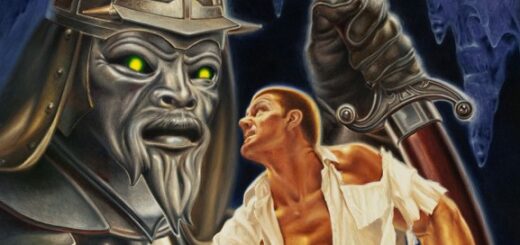
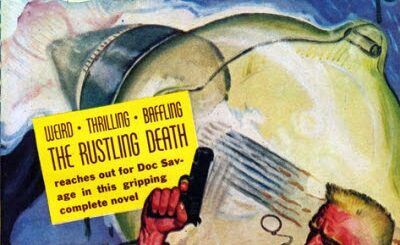
Thumbs up to Emery Clarke for his excellent, action-packed cover painting this issue. Bob Larkin’s painting for the Omni is excellent, as always, but apparently is tied to another story in the volume. Nice color scheme with the figure of Doc by an off-camera light source in a night shot, making for a very dramatic composition.
Final summing up: Better Bogart than usual. Your mileage (and possible literary dyspepsia) may vary.